14th December 2018

There’s something strange about centenaries, anniversaries, ‘#onthisday’s. It feels arbitrary and yet, there is something about the temporal closeness that makes them feel a little more significant than usual. Today, 100 years ago, the first wave of women were able to vote alongside men. Not all women, of course – it would be 10 years until that milestone was reached. But nevertheless, 100 years ago today, Hilda Burkitt would have woken up, gone about her morning business and then, at some point, did what she had given 7 years of her mind, body and soul to gain the right to do.

I can’t imagine how it must have felt as she walked into the polling booth, filled out her ballot and left, having exercised her newly gained democratic right. Only four and a half years previously, she had spent three and a half months in prison, a tube down her throat three or four times a day as she maintained a continuous, unfaltering hunger strike. She had broken into empty buildings and left them in flames, she had broken windows, in- and outside of prison, all while shouting, screaming or leaving in written form “Votes for Women!”

She had also spent days, months, years really, patrolling the streets of Midlands towns and cities, spreading the word for the cause she held so dear. Newspapers in one hand, she climbed up onto chairs or boxes and took a breath before regaling the sometimes hostile, sometimes friendly, sometimes both, crowds of the need for the female vote.

An admittedly infrequent, but still common, response to the commemoration of any suffragette or the WSPU usually invites a number of prickly responses:

But what about the suffraGISTs?

We should remember the suffragists, and many historians have been doing very valuable work into the many alternate forms of suffrage activism and how they overlapped with each other. History does not need to be a competition for attention. Commemorate more women! Commemorate them all!

The suffragettes actually harmed the suffrage movement’s efforts!

I tend to shy away from assessment of (in-)efficacy – is it even really relevant now? The suffragettes did what they did, forming their own microcosm of deeds and words, and that is something that is very interesting.

They were what we would call terrorists now!

Indeed. They were what one might call terrorists then. Indeed, in a 1913 editorial by Christabel Pankhurst in The Suffragette, she even uses the verb.

“Very obvious are the replies to these two points. In the first place, the Suffragettes not only “think”, they know that Parliament can be terrorised into granting reform. They also know that Parliament never grants reform unless it is terrorised. The men terrorised Parliament into giving them the Vote. The Catholics terrorised Parliament into giving them emancipation. The Nationalists (by their votes in the House of Commons) are terrorising Parliament into proceeding with the Home Rule Bill.
Terrorism is, in fact, the only argument that Parliament understands!
– 27 June 1913

It is of course, very reductive to employ that ‘terrorism’ as we understand it now is the same as ‘terrorism’ as utilised in 1913. However, there is a case to be made for the fact that the WSPU was an early form of ‘reform terrorism’ in terms of rhetoric and action.(*) . The fact that the only life lost came from their number does not absolve them of some at times very dubious deeds. However, History is full of flawed, dubious ethics. That’s what makes it so interesting. Terrorists or no, the WSPU are a fascinating entity, and much of the history of this particular union and its membership remains to be explored.

I am of course, biased in my interest in Hilda Burkitt, and will always seek to justify it. Even if sometimes our relation to each other seems far too distant to be anything but nominal, I still feel a connection to her – especially when I catch a glimpse of my mother next to her photograph and see traces of similar facial features, when I see my grandfather in photographs of Hilda’s brother. Similar interests have made their way down the family tree; both the past and present lots have talented saxophonists, accomplished long-distance runners, love for textile arts amongst them. When I saw the photograph of Hilda sitting in the garden for the first time I was taken aback; she poses with a cat on her lap and a Jack Russell at her feet, the same two types of pet that have been part of my family since my early teens.

DuJPKxRXgAE08qY

But regardless, Hilda is fascinating as a historical actor, and I will think about her and her cause a lot today. Her actions went beyond the pale, but then so did those of the government who force-fed her, the crowds who mauled her, the Press who defamed her. Her story is complex, her doings even more so – all the more reason to try and piece it back together, as should be the case for the many other figures across the suffrage movement, whether militant, semi-militant or not militant at all.

The vote was not the final victory – 1918 wasn’t even a full victory. As time has passed, old issues have persisted, new ones have arisen. The fight goes on. But today, and in the future, we can at least take the stories of the suffragettes and draw something from them. Hilda’s shows us that courage, persistence and commitment exist in many forms, usually not entirely morally faultless. If anything, she reminds us, as does the WSPU anthem The March of the Women, that ‘naught can ye win but by faith and daring!’


———————————————————————————————————————-

(*) See The Transfiguring Sword – Cheryl Jorgensen-Earp

Nuneham Park pt. 1

On the 10th July 1912, two women hired a canoe from Salter’s Boatyard on Folly Bridge in Oxford. They paddled down the Thames to Stevens Boatyard in Abingdon, where they stayed the night. Upon being asked by the tourists for recommendations, Mrs Stevens suggested they go back on themselves up the river to visit nearby Nuneham Park. One of the women asked if they would be allowed inside the house, to see the paintings – her companion was an artist. Mrs Stevens said that no, the house was closed to the public.

nuneham.jpg
Labelled black and white photograph of Nuneham House, date unknown. Country Palladian villa surrounded by walls and formal gardens. [Source]
The next day, the two women took the twice-weekly Salter’s river ferry through the Oxfordshire countryside to visit Nuneham. After the ferry moored at the Park boathouse, the two women disembarked and wandered up from the river through the Capability Brown landscaped estate. They then rang at the front door of the Palladian villa and asked if they might come inside to view the owner’s extensive art collection – one of them was an artist and would so like to see the paintings. Doris Gale, daughter of estate manager Henry, politely declined, explaining that the house was closed to the public. The two women returned on the ferry boat to Stevens Boatyard, where they made arrangements for their canoe to be returned to Oxford. They then hired another canoe from Stevens and left, saying they were setting off in the opposite direction to Wallingford.

Oxford and the surrounding countryside were popular tourist destinations, so the Stevenses likely thought little of the two well-to-do ladies and their excursion to Nuneham as they said goodbye at Abingdon. That is, until the day after next, when they would discover the women’s real motive for visiting.

In the early hours of the 13th July, local Police Constable Godden made an unexpected discovery as he patrolled Nuneham Park. Hiding in the creepers of the North Wing of the house were two ‘well-dressed’ women. Asked to explain what they were doing, one of the women answered that they had come up the river and were camping in the area. It was a warm night, too hot to sleep, so they had decided to come and look at the house. Dissatisfied by her explanation, Godden grabbed the woman by the wrist and eventually managed to subdue her. Her companion fled.

After the arrest, a basket and satchel were discovered at the scene. The basket contained three brushes, two cans and a bottle containing substances later found to be methylated spirits, turpentine and paraffin, twelve firelighters wrapped in cotton, four lighting tapers, a box of matches and lock-picking tools. In the bag was a two-foot rule, a torch, more matches, cigarettes, chocolate, a typewritten letter outlining the women’s motives, and a piece of string. Meanwhile, the arrested woman’s identity had been discovered; her name was Helen Craggs and, upon searching her in the police station, a small purple white and green flag carried on her person confirmed her political affiliation. A few hours later, the women’s hired canoe was found in the reeds on the riverbank at the bottom of the gardens. Inside it was food, clothes and several books, one containing a postcard with the lyrics and music for Ethel Smyth’s The March of the Women. In a notebook were written the telephone numbers for Nuneham House and Oxford Fire Station. It was thus confirmed; having stumbled upon the two women on his nightly rounds, PC Godden had prevented what would have been the first serious arson attack on private property by a Women’s Social and Political Union militant. Helen Craggs and her accomplice had also nearly dealt a severe personal blow to an ardent anti-suffragist member of Parliament; Nuneham Park was the country seat of Lewis Harcourt, a member of Herbert Asquith’s cabinet.

The residents and staff of Nuneham House may have been on guard against any suspicious activity by apparently harmless-seeming women. Since his appointment to Cabinet in 1910, Lewis Harcourt had been a consistent target of WSPU ire. Women from Australia and New Zealand were particularly furious that the new Secretary for the Colonies, responsible for their home countries, should be a vocal supporter of the opposing cause. In the days after the infamous Black Friday incident, the windows of Harcourt’s London home in Berkeley Square were broken in revenge by a number of suffragettes who had suffered from the police’s brutal behaviour. (Votes for Women, 25/11/1912)

This was repeated on March 4th 1912, three days after the March 1st mass window-breaking demonstration and five days after Harcourt spoke at a mass meeting at the Albert Hall held by the National Society for Opposing Women’s Suffrage. Ethel Smyth, a well-known WSPU member (who had written the music to The March of the Women, found on the bookmark in the canoe) had distracted police guarding Harcourt’s home by asking for directions before breaking one of his windows (Votes for Women, 08/03/1912). The Monday before the arrests at Nuneham on Saturday morning, Harcourt had moved the Second Reading of the Franchise Bill, stating it would be absurd to set up a property qualification for women when they were about to abolish property qualification for men’ and that he “could not believe that the House was prepared to add ten and-a-half million women to the voting rolls”. (Common Cause – 11/07/1912)

Helen Craggs was a twenty-four year old veteran of the movement. She had originally become a teacher of physics, chemistry and physical education at her former school, Roedean, after her chartered accountant father refused to let her train to be a doctor. She had left her teaching position two years after joining the WSPU in 1908, and eventually held a number of full-time organising positions across London. (1) She was present not only in the deputation that would lead to the infamous “Black Friday” police violence against suffragettes but in another that occurred four days later (Votes for Women, 25/11/1912). Astoundingly, on the Sunday between the two marches and brawls with policemen on Friday and Tuesday, Craggs attended a performance at the Paragon Theatre. After ‘she reconnoitred carefully’, she returned at half past two in the morning with two companions. They entered the building, climbed onto the roof and then over to the roof next door, ‘where, sustained on a few pieces of chocolate, she and her comrades lay through the whole bitter freezing night and through the whole of Monday’. They did this so that Craggs could run down into the theatre during a later meeting ‘to show the Chancellor of the Exchequer that the women had ended the truce’. Craggs managed to shout and wave her tricolour flag before she was swiftly and brutally removed from the building. (Votes for Women, 25/11/1912)

Helen Craggs’s militancy had also escalated in the two years since her surprise appearance at the Paragon Theatre. She had smashed windows on March 1st and been imprisoned. (Votes for Women – 08/03/1912) Two weeks before she was found at Nuneham, she had been detained but released at Llandaff on the 26th June after making a protest at the King and Queen’s visit. As the Royal Procession entered the Cathedral, it was held up for a few minutes by Helen Craggs leaping over the wall by the lych-gate and stopping Home Secretary Reginald McKenna, shouting “Mr. McKenna, you are a traitor to all the women in the country” (Votes for Women, 05/07/1912).

On the afternoon after her arrest, Craggs pled guilty to ‘being found by night on July 13 armed with a dangerous instrument with intent to break and enter the dwelling-house of Lewis Harcourt and to commit a felony’ in front of a special session of the Bullingdon Magistrate Court. She was remanded in custody for a week, having been refused bail. During that week, the authorities made efforts to piece together the womens’ movements in the days preceding the planned arson, interviewing the boatyard staff at Salter’s and Stevens, and the staff of Nuneham House. They also tried to find Craggs’s accomplice, eventually settling on Dr Ethel Smyth. Circumstantial evidence tied Smyth to the scene – she was a friend of Craggs, her song was in the canoe, and she had already smashed Harcourt’s windows in London. What was more, when hiring the canoe in Abingdon, the women had corrected James Stevens as he filled out the boatyard log-book- the name was not ‘Smyth’ but ‘Smith’.

Screenshot_23.png
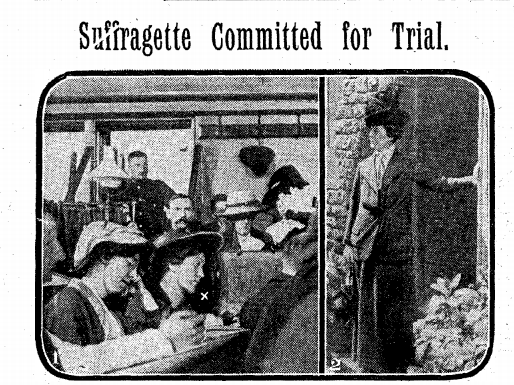
(Daily Mirror, 27/07/1912) ‘Suffragette Committed for Trial’. On the left, a photograph of Helen Craggs (marked with x) whilst on trial in Oxford. On the right, a photograph of Ethel Smyth standing by a doorway.

The following Friday, Helen Craggs stood before the magistrates again. Smyth had been discharged that morning at a private sitting, after witnesses failed to positively identify her as the other suffragette. Smyth remained in court and was one of Craggs’s two £500 sureties when she was released on bail until her trial at the October Assizes.

The attempted arson of Nuneham House was a pivotal moment in the Women’s Social and Political Union’s militant campaign for women’s suffrage. The movement towards large-scale damage to private property had already been initiated some months previously in March, when hundreds of suffragettes smashed central London shop-windows in unison. Many stated that they had been provoked into their actions by the words of MP Charles Hobhouse at an anti-suffrage meeting in Bristol in February 1912. Hobhouse had said that ‘in the case of suffrage demand, there had not been the kind of popular sentimental uprising which accounted for [the burning of] Nottingham Castle in 1832 or the Hyde Park railings in 1867.’ (Votes for Women – 23/02/1912) Standing trial in Oxford five months later, Helen Craggs would also name Hobhouse as her prime inspiration. She made clear in her first two trials that there was no malice in her actions, she was driven solely by her political motives. These were also outlined in the typewritten letter that had been found at the scene, which was subsequently used as evidence in the trial, and printed in full by many mainstream newspapers.

The Nuneham House case is too fascinating (and complex) for one blog entry. In the next post, I will outline Craggs’s trial and further discuss its place in the evolution of WSPU militancy. I will also situate the statements made by Craggs whilst appearing in court within the contemporary WSPU rhetoric and self-representation. Until next week! 

Additional Sources

(1) Elizabeth Crawford, The Women’s Suffrage Movement in Britain and Ireland: A Regional Survey (London: Routledge, 2008).

– Details of the women’s movements gleaned from witness statements are taken from a cross-section of contemporary newspapers, including The Times, The Manchester Guardian/Observer, The Daily Mail and The Daily Mirror, as well as Votes for Women – 12/07/1912 – 10/08/1912.


27/11/18: Suffragette Rhetoric

As part of their Suffragette Stories project, the University of East Anglia has been digitising items from the Annie Kenney archive. I was struck by this letter to Annie by Constance Lytton, written as it emerged that WSPU prisoners, including Hilda Burkitt, were being forcibly fed. 

Whilst Lytton describes it as ‘harrowing’, adding that the Mrs Pankhurst and Lawrence ‘are both ill with it’, she ends with a statement that neatly encapsulates contemporary suffragette rhetoric. 

“But as soon as the public realise it and the ‘laughter’ it has caused in the House, it will, as usual, move on the tide immensely. These heroic women will be only too glad, one knows they are only proud to have been pioneers in this receiving of the Government’s new violence.” 

As WSPU militancy escalated, the movement developed a rhetoric that allowed the members to justify their actions through asserting themselves as “just warriors”, part of a wider, unstoppable force that would secure the emancipation of women. (1) The ‘tide’ of women’s liberation was a frequent image in suffragette propaganda. Similarly, the women were ‘heroines’ in the tradition of historic militants such as Joan of Arc. In the letter above, Lytton draws on both iconographical elements. The idea of the women in Winson Green taking pride in the medical abuse they suffered is slightly jarring, but it is not surprising. Imprisonment, hunger-strike and forcible feeding would later become emblematic of the Suffragette’s tortured martyrdom for the Cause. 

But what of the women inside Winson Green? Outside, Lytton could muse to Kenney, Votes for Women could run on their front page that ‘these women deserve well of womanhood and of the country of their birth; they are setting up a standard of heroism which will be remembered and honoured so long as the annals of human society are preserved’. [Votes for Women, 01/10/09] But how did the women inside Winson Green express themselves? What did they think about it? 

In 1914, Hilda Burkitt’s closing speech at her and Florence Tunks’s trial for arson is deeply imbued with the suffragette rhetoric that had evolved from that mentioned above.

“Whatever sentence you impose I shall not serve, because I have made up my mind that I will not take any food or drink while I am in prison. I cannot stand the torture of the feeding for a great length of time, flesh and blood can’t stand it; and if Mr McKenna does not release me I shall die in prison, in which I case I shall then be the victor, because I shall not have served the sentence. You can give me liberty or death.”
[The Suffragette, 05/06/1914] 

 I had always naively assumed that Hilda’s political statements would have become more ‘extreme’ as the movement progressed. 1909 Burkitt as opposed to 1914’s fully-fledged arsonist and prison veteran seemed quieter, more subdued. I was wrong to assume this. 


Screenshot_21.png
[excerpt of hand-written petition submitted to Home Office in 1909] 
Hilda, in 1909, left no uncertainty around her intent as she declared hunger-strike in a hand-written petition. 


‘so, will you reply to my Petition at once, as if I should [succumb crossed out] die through my fasting my death will lie at your door, but I am ready to lay down my life, to bring about the Freedom of my Sex.
Evelyn Hilda Burkitt.
Women’s Social and Political Union.
[HO 45/10418/183577]

What always strikes me about this document is the trace of Hilda’s thought-process as she wrote, crossing-out the more euphemistic, weaker ‘succumb’ for the far clearer ‘die’. Her self-portrayal as a willing martyr for the Cause makes her seem very much one of the ‘heroic’ ‘pioneers’ that Lytton related to Kenney from outside Winson Green. This self-representation would continue throughout her career. She would also draw on her ‘credibility’ as the first suffragette to be forcibly fed to draw people to drawing room and street meetings. She wore her ‘prison badge’, and likely the hunger-strike medal, presented to her by Christabel Pankhurst at Birmingham Town Hall in November 1909, with pride. 

Reuben 1907.jpg
Photograph of Reuben Burkitt in 1907, taken by his daughter Lillian Burkitt. 

These sources show Hilda Burkitt as she wished to present herself to hostile onlookers and the government. She states her political motives clearly, she is committed to the death. However, Hilda also used similar language in communication with her family. In 1914, she wrote to her father from prison to inform him of her arrest. As she was trying to keep her identity secret from the police, the letter is vague, and sent via her brother-in-law Fred. However Hilda also states that she was

‘not taking food or water, what will be the result I do not know. I am quite prepared to give my life if need be, but I suppose McKenna will desire that’.
[HO 144/1205/22030] 

Of course, Hilda was obviously aware that the letter would be read, and could have been using this as a further outlet of political self-expression. That said, she obviously did not mind her father reading it after receiving it unexpectedly.

Reuben Burkitt was also present in 1909. As the facts of forcible feeding emerged, he wrote to Keir Hardie. Hardie secured him a Home Office permit to visit Hilda in Winson Green, ending his reply hoping Reuben ‘will find your daughter bearing up bravely’. As he left the prison, Reuben was interviewed by a local journalist and described how Hilda had related the entire process to him, including rough handling by doctors. She had asserted its illegality. Sounding slightly resigned, he is apparently quoted as saying ‘ “She is more reconciled now, although she evidently seems to have given more trouble to the officials than all the other Suffragists.” ‘ Burkitt was, according to the Birmingham Daily Gazette ‘in favour of the Parliamentary franchise being given to women […] but he regrets the militant movement in its present form.’ [Birmingham Daily Gazette, 11/10/09]

Reuben was also present, a week later, after Hilda’s release as she gave an interview to the Birmingham correspondent for the London Daily News. She spoke lying on a couch in her home in Sparkbrook. Her father related that she had just been examined by a doctor and her heart was weak. Hilda described how inside prison, the suffragettes were able to ‘cheer one another up by their “tattoo.” “We call our battle-cry our tattoo, you know – ” “Are we down-hearted? No surrender” Miss Burkitt explained’. She also stated that ‘she still justified violence as the only method of agitation open to the Suffragists’. [London Daily News, 18/10/09]

This web of source material is of course limited; it merely provides snapshots of particular moments and statements. However, throughout, we can see echoes of the same images and rhetorical devices that would shape WSPU self-representation. What is more, we see how the suffragettes used this imagery in their own communications to each other, either by letter as with Lytton and Kenney, or through prison cell walls. In the case of Hilda Burkitt, this was extended to their own family, as her father witnessed, either first-hand or by letter, his daughter’s hunger strikes. 

Additional sources

1 – Cheryl R. Jorgensen-Earp, Transfiguring Sword: The Just War of the Womens Social and Political Union (University of Alabama Press, 1997).
See also: Lisa Tickner, The Spectacle of Women (University of Chicago Press, 1988).

Finding Hilda Burkitt


Hilda 1905 (contrast edited).jpg
Hilda Burkitt, sitting at her elder sister’s photography studio in 1905. [Overexposed black and white portrait of a 29 year old woman, she wears white, a pearl necklace and holds a rose. She looks away from the camera.]
My great-great-great aunt Hilda Burkitt was a militant member of the Women’s Social and Political Union. In the seven years she spent involved in the WSPU’s campaign, Hilda was caught up in a steadily increasing whirlwind of activity – selling newspapers, organising, speaking, and finally arson. She was the first of the first suffragettes to be forcibly fed at Winson Green in Birmingham. She was a co-perpetrator, five years later, of ‘one of the most spectacular fires to be attributed to the suffragettes’. (1) This arson attack was also one of the last. Indeed, Burkitt was one of the last women to be released from prison, and thus one of the last to be forcibly fed. Her militant career possesses an eery symmetry – she was there until the bitter end.

Hilda is mentioned once in Sylvia Pankhurst’s and once in Christabel’s respective memoirs of the WSPU movement. (2) She is not mentioned in Emmeline Pankhurst’s at all. Indeed, Mrs Pankhurst, either purposefully, with poetic license, or unintentionally, designated Mary Leigh as the first suffragette to be forcibly fed. (3) This myth has echoed through the historiography. Yet Mary Leigh was on remand and did not set foot in Winson Green Prison until the day after the prison doctors began to forcibly feed Hilda. After being released from Winson Green, Hilda gave a number of talks to different WSPU branches about her time in prison and was marketed as ‘the first suffragette to be forcibly fed’. She included it in her own mini autobiography in the Suffrage Who’s Who of 1913. (4) It was included in her obituary in 1955, likely written by a close family member for the local newspaper.

Why then, has Hilda Burkitt been mentioned so little?

It is not surprising. Much of the current historiography on the WSPU has been drawn from sources that were carefully curated by the Union themselves, after the campaign was finished. In these sources, Burkitt also only features occasionally. As Mayhall and Riddell have observed, a sanitised ‘Suffragette Spirit’ was created, one which carefully swept the ash of burnt buildings and postboxes under the rug. (5) In the words of Edith Mansell-Moullin in a letter to Edith Howe-Martin discussing a potential memoir of Emily Wilding Davison, should she ‘leave out the bombs?’ In her study of the forgotten suffragette Kitty Marion, Fern Riddell points out how Marion was one of many ‘extreme’ militants, ‘yet we know so little about them. They have been erased from the record, deleted by a process of PR and simplified storytelling’. (6)

Burkitt had been a prolific organiser and was frequently mentioned in the regional listings of the WSPU newspapers (Votes for Women and subsequently The Suffragette), either giving meetings or reporting from areas she held temporary responsibility for. She was paid by the WSPU for her services from 1909. In 1913, living in Stoke-on-Trent in Staffordshire, she arranged jumble sales, put on plays and coordinated newspaper sellers in unpleasant weather. She was one of many rank-and-file members who devoted their lives to the cause, and yet these women have also been forgotten. Those who were not included in the suffragette iconography, whose pictures were not sold on postcards to adoring followers, who did not publish autobiographies, have missed the attention of many modern historians. As Jill Liddington has termed it, with ‘celebrity suffrage’, there is a historiographical bias towards well-known figures in the WSPU hierarchy. (7) Whilst Hilda’s contribution has been acknowledged in the extensive research into lesser-known suffragettes conducted by Elizabeth Crawford, the details of her militant career are only now coming to light. (8) Nicola Gauld’s local study into the wider suffrage campaign in Birmingham and the West Midlands has also brought Hilda to the centre stage. (9)

With 100 years since the granting of the vote to the first swathes of women in 1918, interest in the WSPU has boomed. Sources that have previously remained slightly inaccessible have been digitised. (10) The 100 year rule that has classified documentation about individual suffragettes, such as the medical records of their forcible feeding, has lifted. Contemporary historians are in a unique position to expand to a more comprehensive pool of previously unavailable source material.

As Morley and Stanley comment in their work on Emily Wilding Davison, an important facet of reconstructing a subject’s biography is the process of researching the individual, drawing sources together from various archives and libraries. One must ‘assess “the evidence” by assembling it into different patterns, to try and make connections, to look out for and see (sometimes without really knowing what it was that we were looking for) new evidence, new leads’. (11)

Yet Emily Wilding Davison is by no means a forgotten suffragette – she has, inadvertently, become one of the modern-day suffragette memories, alongside women chaining themselves to railings. Much of ‘her archive’ is collected together, in specific places. Autobiographical writing and letters remain for the historian to consider. Hilda Burkitt, however, is scattered through contemporary documents. The only ‘archive’ of her, explicitly, is the dossier kept on her by the Home Office, which includes the daily reports of her three and a half month prison time and forcible feeding in 1914, and snippets of her previous actions (12). Finding her has proven a challenge. The jigsaw pieces of her career have not come in a box at all, they have had to be found first.

Hilda Burkitt in 1901. Image credit [Black and white portrait of 25 year old woman. She is wearing a white blouse, a large hat and a chain necklace. She smiles slightly at the camera]
Of course, ‘Hilda Burkitt the suffragette’ will be in many ways a creation, a particular assembly of facts gleaned from archival and historical records. However, her voice can be found in primary source material. Her most strident, and historically most poignant, words come from the hand-written petitions she submitted to the Home Office from her prison cells. In her first, she states that she is ‘willing to lay down my life, to bring about the Freedom of my Sex’. Her statements in trials project the image of a fierce and determined suffragette, one who demands ‘liberty or death’ from the government. Equally, the brief reports that she wrote from organising positions reveal a self-assured and confident manner.

Hilda Burkitt’s archive is also a family one. I have had the opportunity to connect with distant family members who have inherited, through Hilda’s sister, more personal material. She also appears in my own, paternal grandfather’s archive. Hilda’s face smiles out of a number of candid, relaxed photographs. She sits with a rose on a postcard she sent to my great-great-grandmother, with measurements for a dress. She smiles with her nephew and niece at the seaside. She poses regally in a large elaborate hat.

Finding Hilda has been a slow, at times laborious, at times incredibly exciting detective puzzle. Combing local newspapers, suffragette newspapers and contemporary records has yielded so much and there is still so much yet to trawl. Whilst she will always be my great-great-great aunt, she is also a significant figure in a fractious and violent political movement. Her biography provides a lens through which to view a variety of sides of the WSPU. She also remains a fascinating character – a single, independent woman who supported herself financially and was part of an explosive and brutal early feminism.

Sources
1 – Elizabeth Crawford, The Women’s Suffrage Movement in Britain and Ireland: A Regional Survey (London: Routledge, 2008) 87.
2 – E. Sylvia Pankhurst, The Suffragette Movement – An Intimate Account of Persons and Ideals.
– Christabel Pankhurst, Unshackled: The Story of how We Won the Vote.
3 – Emmeline Pankhurst, My Own Story (London: Hesperus Press, 2015) 146
4 – Various, The Suffrage Annual and Women’s Who’s Who (London: Hanley Paul & co., 1913).
5 – Laura Nym Mayhall, “Creating the ‘suffragette spirit’: British feminism and the historical imagination”, Women’s History Review Vol. 4 Issue 3: 1995.
6 – Fern Riddell, Death in Ten Minutes (London: Hodder & Stoughton, 2018) 298-299.
7 – Jill Liddington, Rebel Girls (London: Little, Brown, 2006).
8 – Elizabeth Crawford, The Women’s Suffrage Movement: A Reference Guide, 1866-1928 (London: Routledge, 2003) 87-88.
9 – Nicola Gauld, Deeds Not Words (Birmingham: History West Midlands, 2018).
10 – See The British Newspaper Archive and The Suffragette Collection on Find My Past  
11 – Ann Morley with Liz Stanley, The Life and Death of Emily Wilding Davison (London: The Women’s Press Ltd, 1988) 69.
12 – The National Archives, HO 144/1205/222030.